Yapp explains AirPlay Mirroring in a simple, easy-to-follow format.
The post helps readers understand how screen sharing and Apple device integration work in everyday use.
Readers interested in Apple productivity and display features will benefit most from this article.
It’s been around for a while, but how can you use it?
Airplay Mirroring, verb; Broadcasting content from iOS device to iOS device. AirPlay began as audio-only wireless streaming between devices, and progressed with iOS 5 to broadcasting visual content from devices to Apple TV. Now, Airplay mirroring can send videos, images, and mirroring of the original device screens to Apple TV across a wireless network. Continue reading →
Yapp explains Project Tango and why spatial technology was getting attention in mobile innovation.
The post gives readers a quick look at a more experimental Google tech initiative.
Readers interested in mobile hardware and future tech concepts will benefit most from this explainer.
Google’s Project Tango experiment made a surprise appearance at the Mobile World Congress this week. It is not a tango-ing robot (but they should make that, just for kicks). Project Tango, noun; An experimental Google smartphone with a number of cameras and vision sensors that can create 3D maps of the spaces surrounding it. Tango was announced earlier in February, and the physical prototype was unveiled at the Mobile World Congress this week. The device has sensors that read the room with hundreds of thousands of measurements per second to create functional 3D models in real-time. It’s similar to the technology NASA used on the Mars Rover to map the Red Planet, but optimized for your smartphones.
Yapp explains 3D printing in a simple way for readers who want a quick introduction to the technology.
The post makes a major innovation trend easier to understand without technical jargon.
Readers curious about future-facing manufacturing and maker technology will benefit most from this article.
The name is pretty self explanatory, but how does the new tech work?
3-D Printing; verb, The process of creating a three-dimensional, solid object from a digital model. 3-D printed objects can be made from plastic, glass, silver, and a variety of other moldable materials. Charles Hull, an American engineer, first developed the digital and physical technology to 3-D print objects in the 1980s. The technology has had a slow evolution into the mainstream, with a boom in the last few years as printers became more readily available and companies began to offer the services to 3-D print.
Yapp explains Oculus Rift and why virtual reality was becoming such a major tech topic.
The post gives readers a quick introduction to VR in a friendly, accessible style.
Readers interested in gaming and immersive technology will benefit most from this explainer.
A newly-crowned Crunchie winner and fan-favorite at last month’s Consumer Electronics Show, the Oculus Rift is about to get even more hype.
Oculus Rift, noun; A head-mounted display for games developed for virtual reality. In short, you can live-play video games with the headset. Though it isn’t available for consumers just yet, the Rift headset will be among the first virtual reality headset available for gamers to use in-home. Like Google Glass, the Rift will run on apps, though most will be games versus Glass’ more personal-assistant based model.
Oculus Rift started as a Kickstarter project in 2012, where they raised close to $2.5 million dollars — ten times their $250,000 goal, which was reached within 4 hours. The prototyped Oculus Rift premiered at the Consumer Electronics Show last month, featuring an OLED display and a motion tracking system to immerse the wearer in the game. Each game being developed for the Rift uses the technology to its specific needs, but all start with the first-person experience; the wearer immediately becomes a part of the game, rather than the controller separated by however-many feet of space between the seat and the screen.
Though games are the focal concept for developers working on Oculus Rift, this Mashable review points out the possibilities of the Rift headset as a second-screen for experiencing media, a virtual experience for medical students, and a tool for virtual reality immersion therapy patients. It was used recently as a part of HBO’s traveling “Game of Thrones: The Exhibition” to put visitors into the world of the hit show.
There isn’t a definite release date on the consumer version of the Oculus Rift headset, but it’s estimated to be within the next year.
UPDATE: Facebook purchased Oculus, the company that created the virtual-reality Rift headset, for $2 billion on March 25, 2014. It’s currently unclear about the deliverability of the product that was backed on Kickstarter, but we can be sure that Facebook will take the Rift in a direction that is likely not what most backers were hoping for. Mark Zuckerberg, Facebook’s CEO, plans to use Rift technology for “communications, media and other forms of entertainment,” a pretty broad and super vague classification. (We imagine this means virtual reality advertisements, and maybe a modern, immersive version of Farmville?) Maybe Facebook hasn’t quite figured it out yet, which has caused many of the more than 75,000 developers who ordered devices to create games and software to express their frustration at their money invested. Because the device was originally funded on Kickstarter, there are a lot of questions and concerns over the acquisition.
Yapp explains Bitcoin in a simple format for readers who want a basic understanding of the topic.
The post turns a complex digital finance idea into a more approachable overview.
Readers curious about cryptocurrency and digital payment trends will benefit most from this article.
You’ve heard a ton about it, from the stock market to small businesses. But how does it work?
Bitcoin,noun; An Internet-based virtual currency. You can’t get bitcoin from your local bank, but through exchanges or mining. Like coal and gold mining, mining for bitcoins is difficult. A miner makes computer hardware solve complex math problems that confirm transactions through the system, creating an open-source security system. Miners are rewarded with newly “minted” bitcoins. It’s referred to as mining because, like physical mining for resources, it requires work (mental more than physical) and slowly makes the new currency available at a rate similar to gold, which is mined. Bitcoins can also be obtained through online exchanges, just like gold.
There are 21 million coins for the people to mine. So far, 11 million have been uncovered and move about society; as the 10 million remaining continue to be mined, the equations to discover them become more and more difficult so that coins won’t flood the market and implode. Unlike national currency, which can be printed and introduce inflation, bitcoins are finite. But, like all money, their value depends on their surroundings. As valuable as people see bitcoin, that’s how its price is set. This makes it incredibly volatile; it is uninsurable and can’t be returned. There isn’t central regulation, it’s easily hackable (since it’s totally virtual), and the value of a bitcoin jumps and falls drastically from day to day.
On the other side, Bitcoin is freeing. It is a completely tax-free type of money that can be exchanged directly from person to person with no banks involved. For small business owners, it is a great option that is extremely low cost, gives high visibility (as long as Bitcoin is trendy) and is easy for international transactions. And though it’s still a bit rocky as a currency, it’s market valuation caps at $10 billion — so, it’s not going away fast. As it becomes a more common and “liquid” currency, it’s possible that you’ll be paying for your coffee virtually.
Yapp rounds up blogs worth following for readers interested in mobile apps and app-related trends.
The post helps readers discover useful sources for ideas, updates, and industry perspective.
App creators and mobile enthusiasts will benefit most from this reading list.
There are a ton of great blogs to follow for all things mobile. We spend a ton of time reading a ton of different blogs to keep up on the trends and movements in the mobile world. Some, you get tired of. This list is full of blogs we come back to and love to read every day, and are ranked in no particular order. Let us know in the comments if there’s one we’re missing!
Yapp explains jailbreaking in a straightforward way so general readers can understand the concept.
The post offers a simple take on a mobile topic that often sounds more technical than it is.
Readers interested in smartphone software and device customization will benefit most from this explainer.
How does your hacker friend get that cool custom look on his iPhone?
Jailbreaking;v, To access the root of the iOS operating system in order to make customizations to a device. (It sounds a lot scarier than it really is.) Remember when we told you about Android Launchers? Those apps help Android users easily give their phone it’s own custom look on top of the system the phone is running. But people running iOS don’t have these apps and options.
Because iOS is a universal Apple operating system that isn’t open to public contributions, launchers and customizations are much harder to make. This closed ecosystem is one reason many users compare it with broader mobile innovations like native apps and their best features.
That’s where jailbreaking comes in. When you access the iOS operating system acting as an administrator, you can download extensions, themes and other apps to add special features like shortcuts or design tweaks to your phone. Jailbroken phones can still use iTunes, the app store, and function generally the same. Aside from customizations, jailbreaking also allows access to apps that weren’t approved for the iTunes the app store.
Many of these are extensions like Android Launchers, allowing you to apply custom pieces on top of your existing OS. The Cydia app store hosts these apps and others that didn’t make it into the iTunes store, much like how discussions around top downloaded apps on iOS and Android highlight what users want from their mobile experience.
(P.S.; Jailbreaking is different from unlocking, which frees your phone to work on any carrier — like Verizon, AT&T, T-Mobile — rather than just the one it was purchased from and is illegal if it isn’t done by the carrier.)
Yapp explains Google Glass and why wearable computing captured so much attention.
The post gives readers a quick look at an ambitious product in approachable language.
Readers interested in wearable tech and digital innovation will benefit most from this article.
These wearable gadgets have been around for a while now, but the hype hasn’t died down. What are they all about?
Google Glass, n; A wearable computer system that adds a display to your daily vision. With it, you can view the time, date, weather, traffic information, all without using your hands. You can’t buy Glass quite yet — it’s only available for Glass Explorers and chosen developers — but it’s rumored to become available sometime this year.
Basically, it’s like your smartphone (but likely smarter) and it’s on your face. You can take pictures of the sunset to post to Facebook by winking. You can find the road less travelled with a map overlaid on the fork in front of you. It’s mainly controlled by voice and gesture commands, which means eventually, everyone could be talking to their headsets instead of staring down at their phones.
Glass’ basic premise builds on “augmented reality.” It adds a layer of context to the time of day, your location, or the connected gadgets nearby to keep a running feed of what’s important to you in your eyeline (literally). It runs on apps, just like your phones and tablets. Google Now — a cards-centric app that Google uses to remind you of appointments, tell you what’s happening nearby, and when you should leave to make your 2:00 meeting — will be less avoidable when it chirps in your face. Your favorite social networks will likely be available (if they aren’t already) on Glass by the time it’s ready for general purchase. There are also tons of other cool apps being developed specifically for Glass, like this one from a North Carolina firefighter that will help his firefighting colleagues stay safe or OpenGlass, which wants to help the blind and visually impaired.
Who knows how Google Glass will be received once the public gets its’ hands on it, and what other uses will emerge.
Yapp explains OLED technology in a simple, readable format.
The post helps readers understand why display quality and screen innovation matter in consumer tech.
Readers interested in smartphone and display technology will benefit most from this explainer.
If you just figured out the difference between the curvy light bulbs and the old ones, let us introduce you to something completely new.
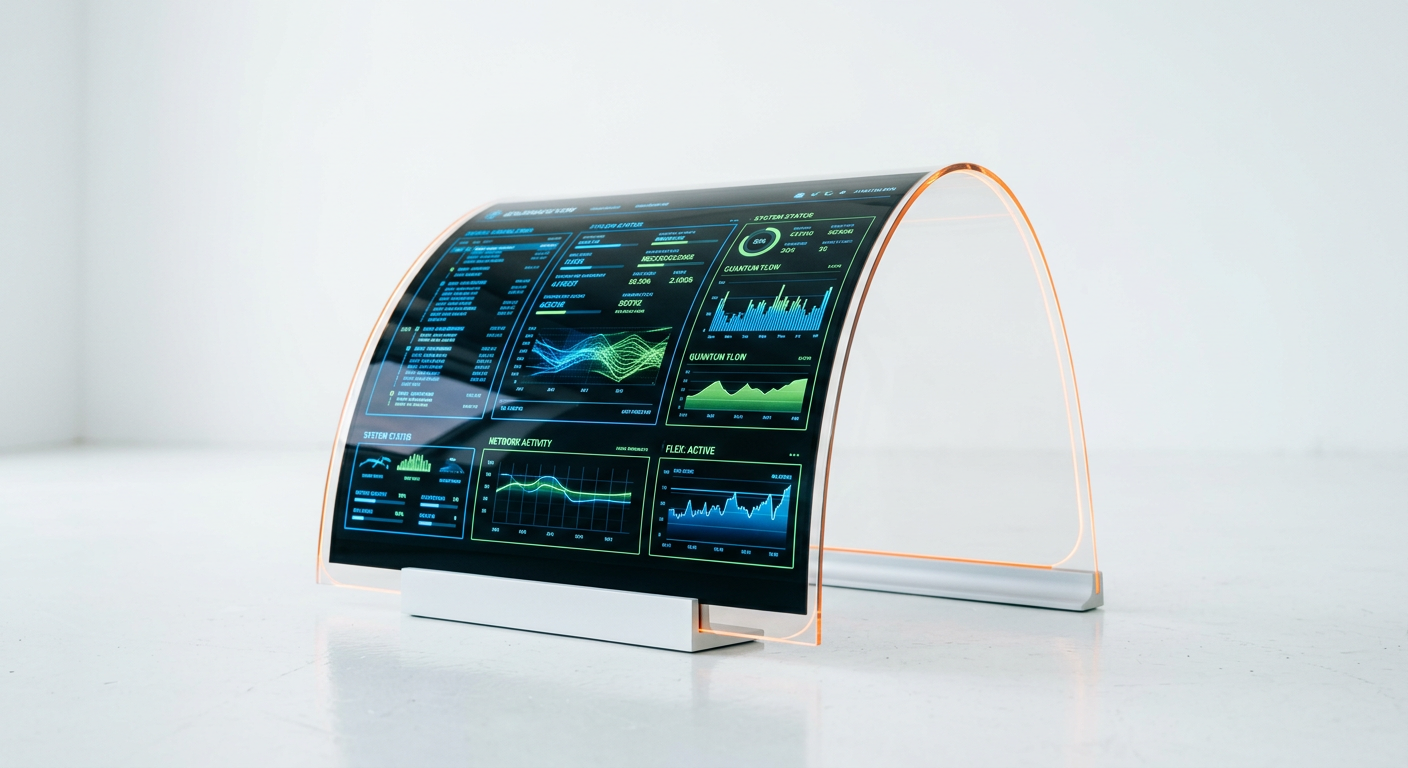
OLED, n; A reemerging style of lightweight light technology used to create digital displays. In long form, OLED is an “organic light-emitting diode,” and if you followed last week’s Consumer Electronics Show, you probably heard about it. OLED is the digital lighting style that has given way to bendable or curved screens. Remember Samsung’s Galaxy Round? (Probably not.) It was the first curved smartphone, created with an OLED display. LG followed with another curved phone, neither of which really took off. But at CES, LG announced a line of flexible televisions that curve theatrically with the touch of a button.
All of these gadgets are no doubt cool, but what’s the benefit of creating with OLED? It goes beyond literal flexibility; you can use OLED to create light-emitting clothing (like Philips did for the Black Eyed Peas) and transportable displays that EMTs, vets, and other on-site workers can use. OLED is so light that is can be incorporated into glass, which opens the door to a totally connected lifestyle, a la Minority Report. Corning, the glassware creator, created this video in 2011, showing a smart home in which everything is connected by technologies like OLED embedded in glass.
Though still in its infancy, OLED is already growing popular among hardware creators. Creators from Samsung to Philips to Corning believe that OLED’s flexibility will lead to more multifaceted and less breakable devices.