Yapp shares a graduation-themed Yapper Monday feature that highlights creative app use around milestone events.
The post shows how apps can bring people together around celebrations and shared moments.
Readers looking for event inspiration tied to graduation season will benefit most from this feature.
Congrats, Class of 2014! Check out these apps from the year’s seniors and graduates.
Bryant University Commencement
For the second year, Bryant University is using Yapp to organize their commencement ceremony. Their app has listings for all the meetings and ceremonies necessary for grads, plus other pertinent information for families, visitors, and students.
Hoyas Senior Week
The senior class committee at Georgetown University put together an app for their Senior Week. It holds a full schedule of the week, from Disney Movie Marathon to a Neverland Kegger on to senior convocation and a graduates’ ball.
Davis Grad Night
The high school grads in Davis, Calif., have a chance to party after graduation in a safe and healthy environment with their fellow seniors. The app is using a poll page to find out what students have heard about previous grad night parties.
Yapp rounds up five apps that can make life easier or more fun for moms.
The post offers simple, relatable app recommendations for everyday needs and family life.
Readers looking for family-friendly app ideas will benefit most from this roundup.
To all the moms, today we salute you. Happy Mother’s Day!
Whether you’re loading mom’s new smartphone or tablet before wrapping it up or want to add a few tech-savvy gifts to the mix, check out these 5 apps perfect for any mom. Continue reading →
Yapp highlights Mumble Jumble as part of Autism Awareness content that spotlights helpful apps and tools.
The post connects mobile technology with more inclusive communication and learning support.
Readers interested in autism-related app resources will benefit most from this feature.
April is Autism Awareness Month and we have been featuring an app each week that is loved by and influential in the Autism community. This week, as our final installation, take a look at Mumble Jumble, an iPad app that helps conversation.
Yapp explains Nymi and why biometric identity technology was gaining attention.
The post gives readers a simple introduction to a more advanced wearable tech concept.
Readers interested in security, biometrics, and wearable technology will benefit most from this explainer.
An ID band that opens doors to, well, everything.
Nymi, n; A new wearable device that uses your heartbeat to verify your identity. Nymi creates a password from your unique cardio signals, which are only a bit less secure than our unique fingerprints. It will enter the market as a remote to your accounts and gadgets that can be controlled only by you. But, that market (your wrist) is already pretty full — you’ve got smartwatches, exercise monitors, regular watches, bracelets, pony tail holders; why make room? Continue reading →
Yapp features the Mobil Film Festival as a Yapper Monday spotlight on creative app use and mobile-first experiences.
The post shows how apps and mobile technology can support arts, events, and community engagement.
Readers looking for creative event app inspiration will benefit most from this feature.
Next month in San Diego, Calif., a film festival screening only flicks created totally on mobile devices returns. In it’s third year, the International Mobil Film Festival, hosted by S. Botello Productions, is going even more mobile with an app from Yapp.
Alongside the festival, S. Botello Productions runs other programs with the Mobile Film Resource Center, including a mobile film school and distribution channel. The company’s founder, Susan Botello, is now working on implementing mobile filmmaking in schools.
We chatted with Susan Botello, who can now add ‘app creator’ to her founder title, about the festival and it’s newest addition — a mobile event app.
How did the Mobil Film Festival get started? It began as an idea in 2001 that came around again and again but there were real limits to implementing it. For example, you could not show a film on a big screen, because the quality of video cameras on phones was poor. The internet in 2005 & 2006 was an option for an online film festival, however, the internet was still limited when it came to video and the average person had a very hard time uploading videos that played well over the internet. In 2010, when the first HD quality video cameras entered the mobile phone industry, SBP decided the time had arrived.
The idea was that anyone could do it. Everyone around the world, just about, had a mobile phone. I pitched the idea to everyone on the street, on the internet — everyone. You’d think I was peddling it. And in many ways I was…it was my vision of the future I was trying to convince every person I came in contact with. “Everyone just has to try it and the world will realize this is awesome.” That’s what I thought. Out of this came “Community Stories” which encourages every day people to share the stories of their communities and cultures from within.
What kind of apps do the filmmakers use to create their festival submissions? We are not all about any particular brand or make when it comes to phones so we don’t limit apps usage. The only thing we do not want for our film festival are apps that edit your video for you and make the editing decisions for the user. However, we do share the apps that filmmakers tell us are the best. They do change as new app developers join the “game” of mobile filmmaking. I will name a few apps here that are consistently winning the hearts of filmmakers.
FilmicPro is an app used for filmmaking by the best mobile filmmakers around the world. It has settings that allow you to white balance and set frame rates, which is pretty cool and there are many more features. FilmicPro is also endorsed by the best of the filmmakers in the world of mobile film.
Splice is an editing app that is free. Splice allows simple video editing on the phone and you can include an audio track from iTunes. It is very basic, but if you are on the field and want to produce a quick story on video this is one quick and free way to do it. But we don’t require anyone edit on the phone or record audio on their phone, just video.
Speaking of audio, there are ways to record audio with your phone by attaching a microphone like a shotgun mic. One way is to use a product named iRig. There are several models but you want the one that allows you to plug a mic into your phone and it allows you to plug in the XLR cable directly to it.
What’s the coolest thing you’ve seen at the festival? The coolest thing is to watch the filmmakers network and when they walk the red carpet. This year I am noticing a new genre in the film industry that is emerging due to the creativity in mobile filmmaking and it is what I had hoped would happen. When it comes to the audience, it is quite moving to watch them in awe as they enjoy the films on a bigger screen. To watch an audience member in awe and for them to ask you questions about how they can make their own because they are so inspired…that’s the topping on the cake — it inspires people to go and realize their dream. We are trying to help them realize their dream.
Do you have a favorite submission? I have many favorites because I love film and art. I really like them all a lot. I believe in people and when they send me a film and I see the work they have done I am inspired. I don’t judge the films and plan to never do that. I hope I never have to. For that we have a judge panel and they are professionals. Even if my favorites don’t take the first prize the panel decides on winners and I always feel it was a fair decision. But the filmmakers are pioneers in an industry that will probably be mainstream soon. Not only do I commend them for being a part of MFF but we try to keep assisting the filmmakers, winners or not. We do this by connecting them with professionals and promoting their work and successes. We also refer and share their successes and work with our partners like the other mobile film festivals which are part of our collaborating partners from Macedonia, New Zealand, South Korea and Spain. There are such a diverse amount of films from very creative to very cinematic and everyone should come see the films, meet mobile filmmakers and be inspired.
What’s your favorite thing about mobile technology? That we all have it and that we can fit it in our pocket. I believe the fact that smartphones can be put on a table or in our pocket as far as designs go, the rectangle screen shape that fits just about everywhere on the go is ideal. It is also a tool that with apps can be a magic wand for us. I like how in order to update them you don’t necessarily have to go out and buy a new one just keep on top of updates and researching the best apps for your lifestyle. The fact that almost everyone has them is the reason investing in them is successful as well. With a phone, you can be completely connected to the world and when it comes to storytelling, which has been around moving the world forward since the beginning of time, mobile technology can tell stories that could never have been told before by everyday people and we can access them with the same technology everywhere in the world. With phones in the right hands the world can be a better place.
What’s the future of mobile filmmaking, from your perspective? I see the future of mobile filmmaking going mainstream. We are working on the mobile film school, which we plan to accredit, and all our programs by setting up a resource center with global access so that when people are out looking into it they find a place designed by the pioneers in this “parallel” film industry. There are phones coming out with 4K capability too. Things are looking great for the mobile filmmaking industry and also I should note that in order to tell a story with film and video it’s not just about pushing the record button on your phone or camera. There are things we can teach you in our workshops that will enable you to do a great job! Mobile filmmaking has a lot of benefits. But it also has complications as it is still evolving. I would like to encourage the industry to contact me and develope more accessories for mobile filmmaking.
What’s the best part about having your own mobile app for your festival? The fact that we don’t have to print programs and mail or hand them out is pretty cool. But we are all about innovation and creativity, so it makes sense to have an app for our film festival and we love the idea of not having to carry paper programs while holding our phone and our drink. And we always seem to have a phone in hand and a drink on the other don’t we?
But there is one more benefit. You guys are telling your customers that you can do more than what you offer by offering it just by asking you. For example, your Q&A asks about the photos for the “Crowd Pictures” during the event, which is a feature of the app. They asked how they could download them from the app and you say you will do that for us just by asking. High five! You rock!
Yapp explains Apple CarPlay and why it mattered in the evolution of connected devices.
The post offers a quick introduction to in-car mobile integration in plain language.
Readers interested in Apple and automotive tech trends will benefit most from this explainer.
Apple’s update to iOS 7.1 includes a few great tweaks and one big new leap.
CarPlay, noun; An in-car integration with your iOS device. CarPlay software primarily uses a voice command system that lets you take hands-free calls, dictate text messages, and browse through your music library by thinking out loud. It also integrates mapping and will work like a smarter GPS to navigate you to your destination. The new software will be available in a variety of cars to iPhone 5, 5C and 5S users who hook up their phones. Cars that integrate CarPlay will be built with touchscreen displays and controls on the steering wheel to keep the platform as eyes-free as possible. Along with Apple apps like iTunes, Maps, SMS and phone, third-party apps like Spotify and Beats Music are available; that selection is likely to grow as the system is adopted, but only to include apps that can be utilized and controlled by Siri.
CarPlay, while not the perfect solution to non-distracted driving, is a forward-thinking step for a world of smartphone-obsessed commuters. The goal is to minimize time spent looking at the display (or at a phone). Mainly, the system is controlled by communicating with Siri, who will dial, text, and select music via voice command. “She” will also be able to search through emails and text messages for addresses to predict where you’re traveling to and navigate for you, taking out the step of typing in or having to adjust by hand a destination address.
The first cars with CarPlay — models from Ferrari, Mercedes-Benz and Volvo — debuted at the Geneva Motor Show, and future partners will include Nissan, Honda, GM and others. Some older models that have digital displays may be retrofitted to work with CarPlay, as well.
Yapp explains 3D printing in a simple way for readers who want a quick introduction to the technology.
The post makes a major innovation trend easier to understand without technical jargon.
Readers curious about future-facing manufacturing and maker technology will benefit most from this article.
The name is pretty self explanatory, but how does the new tech work?
3-D Printing; verb, The process of creating a three-dimensional, solid object from a digital model. 3-D printed objects can be made from plastic, glass, silver, and a variety of other moldable materials. Charles Hull, an American engineer, first developed the digital and physical technology to 3-D print objects in the 1980s. The technology has had a slow evolution into the mainstream, with a boom in the last few years as printers became more readily available and companies began to offer the services to 3-D print.
Yapp shows how mobile apps can replace paper clutter and scattered information with a cleaner digital experience.
Centralized updates and content make communication easier to manage and easier to access.
Event organizers and teams looking to simplify information sharing will benefit most from this approach.
There are tons of apps on the app store — and thousands of them could free up space in your home forever.
We found 18 household hardwares that could easily be tossed and replaced by a few bytes on your phone. And for most of them, the options are vast when looking at both the Android and Apple app stores. Check out our infographic below, which shows just which items run abundant in apps and which are more rare.
We’ll be diving deeper into this idea of tossing the hardware every week, wading through the masses and finding the best apps to declutter your life.
Have suggestions of items or apps we should consider? Leave us a comment below.
Yapp explains Bitcoin in a simple format for readers who want a basic understanding of the topic.
The post turns a complex digital finance idea into a more approachable overview.
Readers curious about cryptocurrency and digital payment trends will benefit most from this article.
You’ve heard a ton about it, from the stock market to small businesses. But how does it work?
Bitcoin,noun; An Internet-based virtual currency. You can’t get bitcoin from your local bank, but through exchanges or mining. Like coal and gold mining, mining for bitcoins is difficult. A miner makes computer hardware solve complex math problems that confirm transactions through the system, creating an open-source security system. Miners are rewarded with newly “minted” bitcoins. It’s referred to as mining because, like physical mining for resources, it requires work (mental more than physical) and slowly makes the new currency available at a rate similar to gold, which is mined. Bitcoins can also be obtained through online exchanges, just like gold.
There are 21 million coins for the people to mine. So far, 11 million have been uncovered and move about society; as the 10 million remaining continue to be mined, the equations to discover them become more and more difficult so that coins won’t flood the market and implode. Unlike national currency, which can be printed and introduce inflation, bitcoins are finite. But, like all money, their value depends on their surroundings. As valuable as people see bitcoin, that’s how its price is set. This makes it incredibly volatile; it is uninsurable and can’t be returned. There isn’t central regulation, it’s easily hackable (since it’s totally virtual), and the value of a bitcoin jumps and falls drastically from day to day.
On the other side, Bitcoin is freeing. It is a completely tax-free type of money that can be exchanged directly from person to person with no banks involved. For small business owners, it is a great option that is extremely low cost, gives high visibility (as long as Bitcoin is trendy) and is easy for international transactions. And though it’s still a bit rocky as a currency, it’s market valuation caps at $10 billion — so, it’s not going away fast. As it becomes a more common and “liquid” currency, it’s possible that you’ll be paying for your coffee virtually.


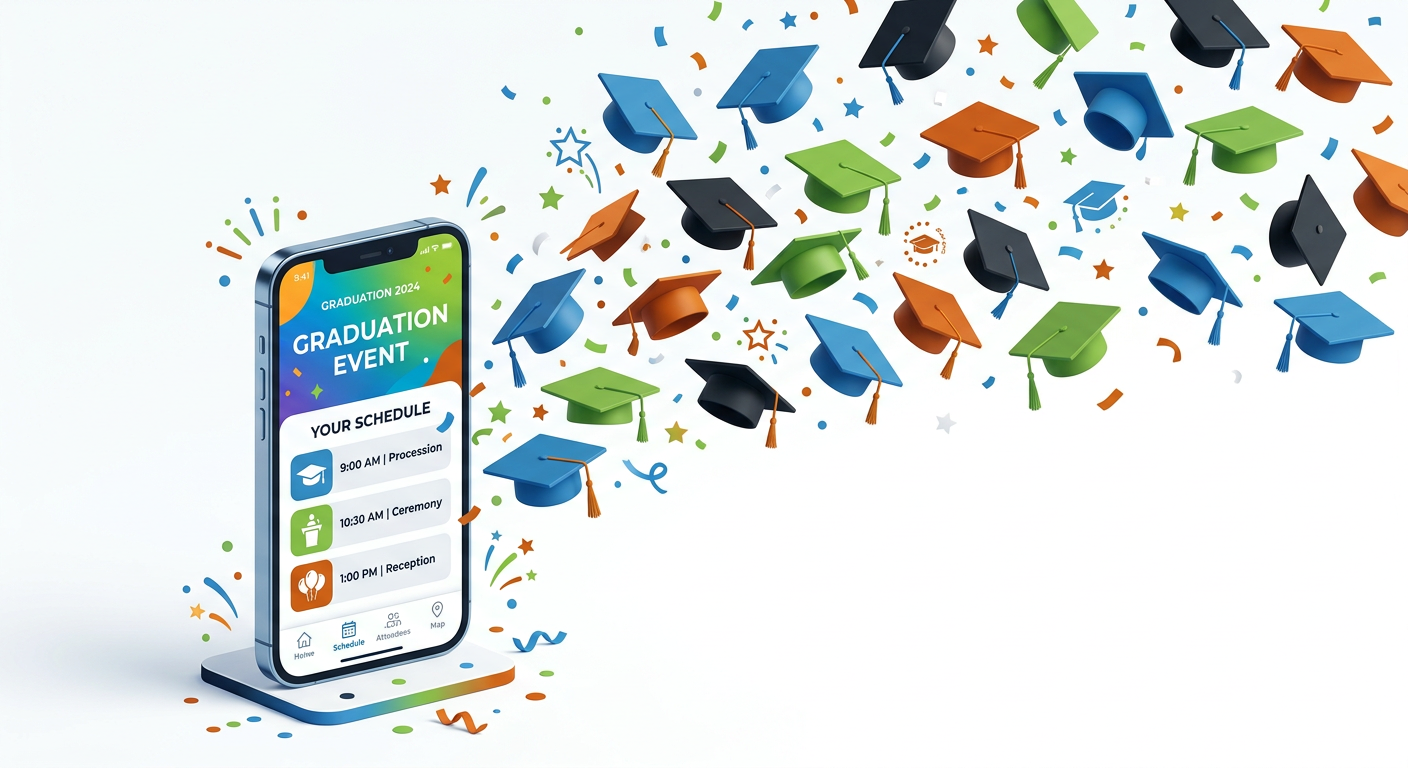


 For the second year, Bryant University is using Yapp to organize their commencement ceremony. Their app has listings for all the meetings and ceremonies necessary for grads, plus other pertinent information for families, visitors, and students.


 The senior class committee at Georgetown University put together an app for their Senior Week. It holds a full schedule of the week, from Disney Movie Marathon to a Neverland Kegger on to senior convocation and a graduates’ ball.


 The high school grads in Davis, Calif., have a chance to party after graduation in a safe and healthy environment with their fellow seniors. The app is using a poll page to find out what students have heard about previous grad night parties.


